In the brutal, fluorescent-lit world of office politics, there are few things more sacred than the private office. It is the holy grail. The promised land. It is the one thing that separates you from the mouth-breathers and loud-typers of the cubicle farm. And once you have one, you do not give it up. Ever.
Our story begins in the ancient, pre-plague-panic times of 2023. A woman named Jenn, who worked in our narrator’s building, left for maternity leave. After the baby, Jenn did what any sane person would do and took advantage of the company’s work-from-home program. This left her private office, with its walls and window and door, sitting empty.
Enter our narrator. This is not a villain, but an opportunist, which is so much more respectable. This person, currently rotting in a “crappy cubicle,” saw a power vacuum. They didn’t just sneak in; they did the paperwork. They put in a formal request with their manager and were given the green light. They moved in, lock, stock, and stapler. They had won the game.
For a glorious period of time, life was good. There were windows. There was privacy. There was probably a lot of quiet, peaceful work getting done, far from the madding crowd. The narrator had become adjusted to the good life.
And then, the email dropped. The one we all dread. The company announced that work-from-home was ending. All employees, like animals being herded back into the pen, were to be back in the building by a set date. The following day, the WFH employees came in for tours and desk assignments, like a new class of kindergarteners.
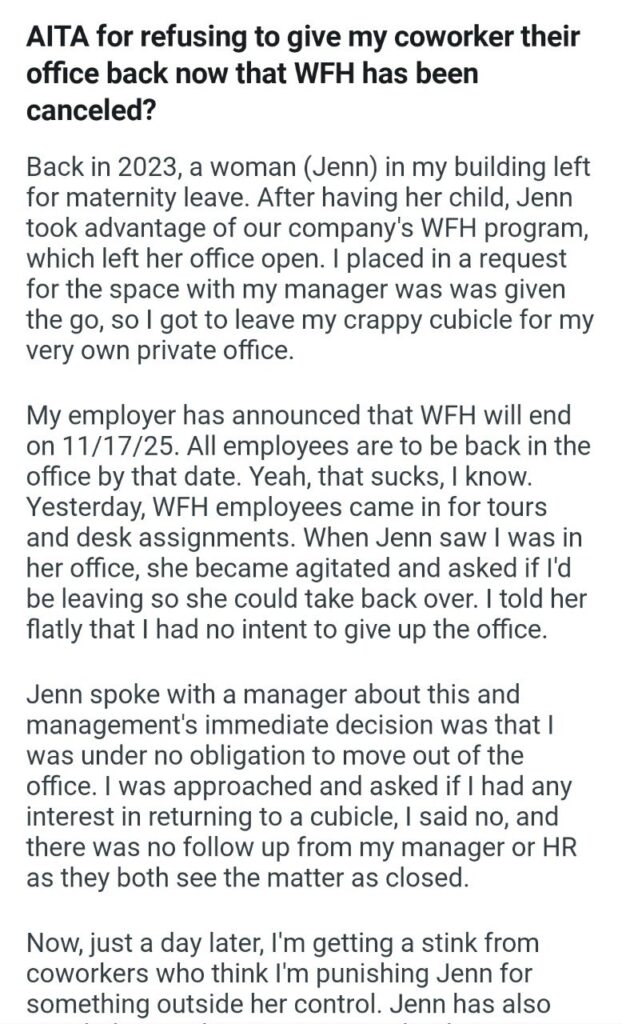
This, of course, is when Jenn, the new mom, saw our narrator in her old office. And she, quite understandably, became “agitated.” She asked if the narrator would be leaving so she could “take back over.” And the narrator, with the icy calm of someone who holds all the cards, gave her a flat “no.”
I am obsessed with the sheer, unblinking power of that “no.” It is a work of art. Jenn, as is her right, immediately escalated to a manager. And in the most savage twist of all, management sided with the narrator. They confirmed that the narrator was under no obligation to move, asked them once if they wanted to go back to a cubicle (lol), and when they said no, management declared the matter “closed.”
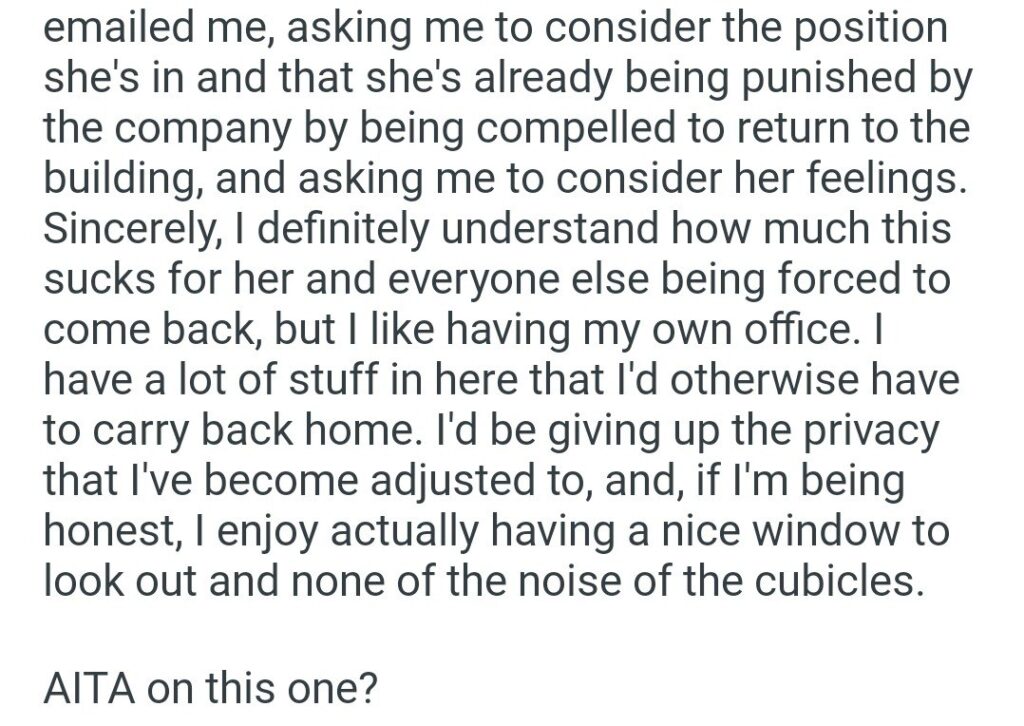
Now, as you can imagine, the office is in chaos. The narrator is getting the “stink” from coworkers, who think they are “punishing Jenn” for having a baby. Jenn herself has sent a desperate email, asking the narrator to “consider the position she’s in” and that she’s already being “punished” by the company.
And our narrator’s internal monologue is just chef’s kiss. They admit they understand it sucks for her, but also, “I like having my own office.” They have “a lot of stuff in here” they don’t want to carry home. They like the “nice window” and the “privacy.” This is the most honest, relatable, and unsympathetic take I have ever seen, and I am living for it.
So, is the narrator the ahole? Look, the optics are terrible. It’s the new mom versus the office squatter. It’s a tale as old as time. But let’s look at the facts. Did the narrator steal this office? No. They filled out a form. Management gave it to them. Jenn didn’t own the office; she was just borrowing it from the company, and then she left it empty. Our narrator simply claimed the abandoned throne.
This isn’t a fight between the narrator and Jenn. This is two employees being put in a terrible position by a company that could solve this in five seconds by, you know, managing. The company is the real villain for forcing everyone back and having no plan. The narrator is just the one who refuses to be a victim twice. You do not give up the window. You never give up the window.