Grief is a beast that tears you apart from the inside out. It is messy and nonlinear and culturally specific. There is no right way to grieve, but there is definitely a wrong way to treat a grieving mother. One woman on Reddit shared a story so heartbreaking and complex that it forces us to look at the intersection of cultural traditions, global politics, and the lingering scars of a broken marriage.
The story begins with a young Indian woman who moved to the United States on a student visa. She fell in love with a man named “Dean,” and despite her family’s initial hesitation, they got married. But the fairytale ended abruptly. After the birth of their daughter, Asha, the mother suffered from severe postpartum depression. Instead of being a partner, Dean stepped out. He started a two-year affair with a coworker named Laura. When he got caught, he didn’t fight for his family. He admitted he was in love with the other woman and left his wife alone in a foreign country with no support system.
Fast forward to February 2020. The mother took Asha to India to visit her extended family who had never met the little girl. We all know what happened next. The world shut down. Borders closed. What was supposed to be a three-month trip turned into an indefinite stay. And then, the unthinkable happened. One afternoon, Asha complained of stomach pain. An hour later, she was gone.
I cannot stress enough how devastating this is. To lose a child is the ultimate nightmare, but to lose a child suddenly, in the middle of a global pandemic, while stuck in a country your ex-husband cannot enter, is a level of trauma that is hard to comprehend. Because the borders were sealed, Dean could not fly to India. The mother was left to handle the funeral alone. Following her Hindu customs, she cremated her daughter and immersed the ashes in the Ganges River. This is a sacred, final act of releasing the soul.
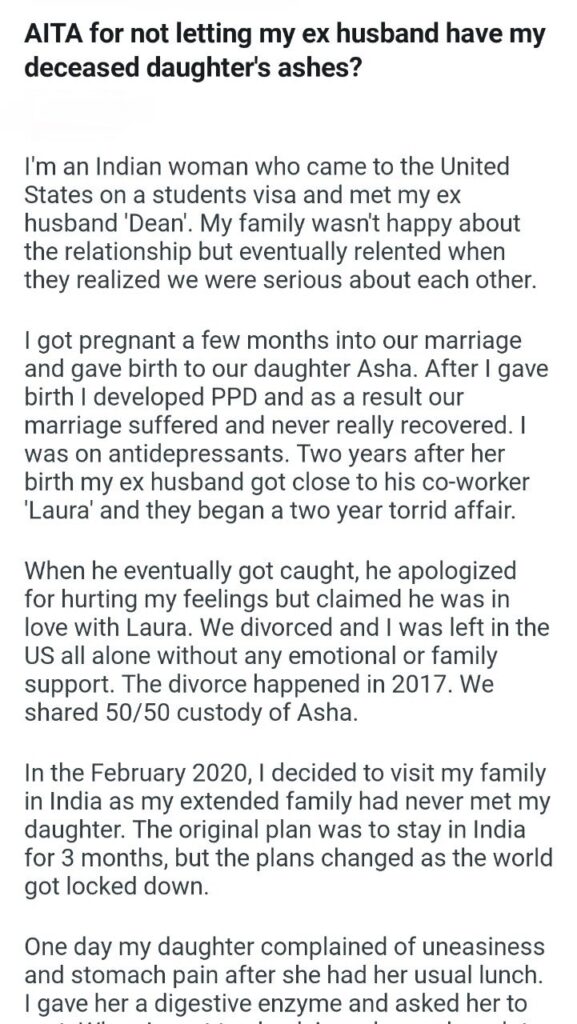
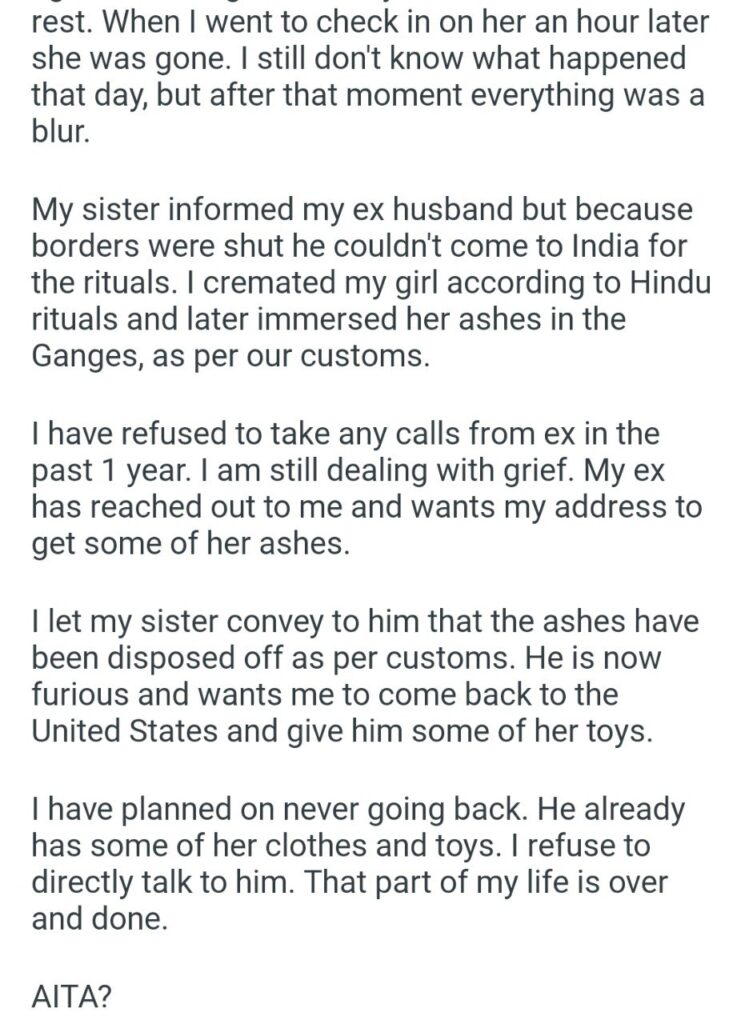
This is where the cultural disconnect and the ex-husband’s entitlement collide violently. For the past year, the mother has been grieving in silence, refusing to speak to the man who betrayed her. Recently, Dean reached out. He wanted his daughter’s ashes. He wanted a physical piece of her to hold onto.
The mother had her sister convey the message: there are no ashes to give. They were immersed in the holy river a year ago. That is the ritual. That is the end. Dean did not take this well. He is furious. He seems to view the cremation through a Western lens, assuming there is an urn sitting on a shelf that his ex-wife is hoarding from him. But you cannot gather water from a river once it has flowed downstream.
Now, Dean has pivoted to a new demand. Since he cannot have the ashes, he wants his ex-wife to fly back to the United States immediately. He wants her to hand-deliver some of Asha’s toys. Keep in mind, this man already has some of his daughter’s clothes and toys at his house in the US. He isn’t empty-handed. He is just demanding more.
The mother has absolutely no intention of returning. Her life in the US was marked by isolation and betrayal. Her daughter is gone. Her support system is in India. She stated clearly that she considers that part of her life over and done. She is refusing to disrupt her healing process to satisfy the demands of a man who broke their family long before tragedy struck.
So, is she the ahole? No. Absolutely not. N-T-A. This woman did the best she could during a global crisis. She honored her daughter with the sacred rites of her culture. She didn’t “dispose of” the ashes out of spite; she liberated her daughter’s soul according to her faith. Dean’s grief is valid, but his demands are not. You cannot demand someone cross an ocean to bring you a stuffed animal when you are the one who left her isolated in that country in the first place. She owes him nothing but the space to grieve on his own, just as she is doing.