We have all heard the debate about screen time. Is it melting our brains? Is it the future of education? Usually, the answer lies somewhere in the middle. But every once in a while, a situation pops up that makes you want to throw every tablet in the world out a moving car window. One grandmother on Reddit recently found herself in the middle of a literacy crisis with her fourth-grade granddaughter, and her refusal to rely on an iPad “babysitter” has caused a family war.
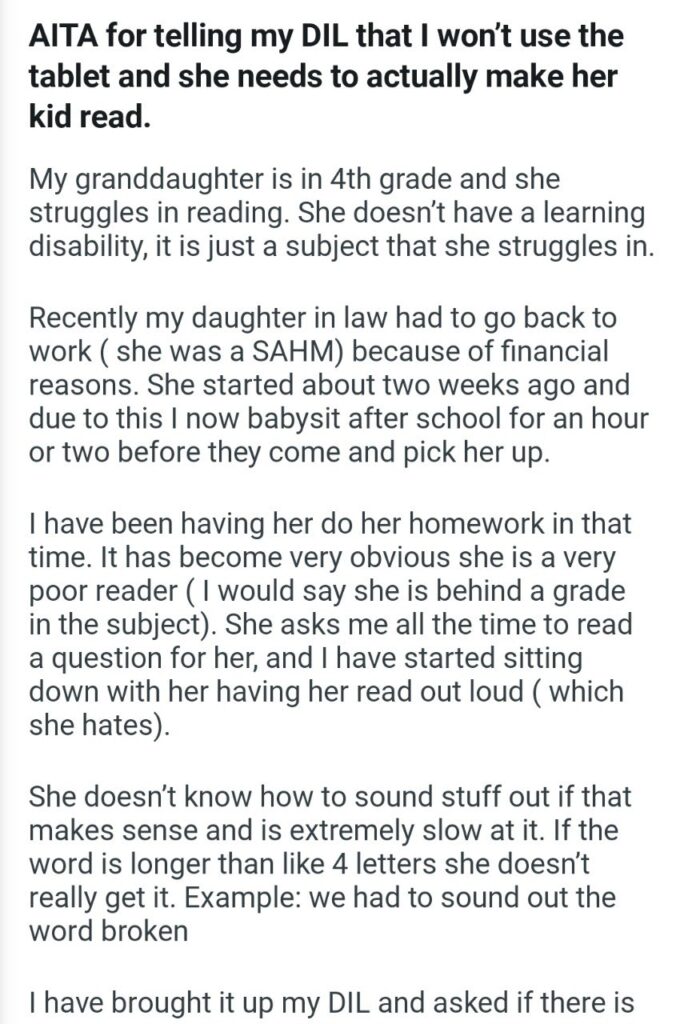
The OP (Original Poster) recently started babysitting her granddaughter after school because her daughter-in-law (DIL) went back to work for financial reasons. This seems like a standard, helpful grandparent arrangement. However, once the OP started overseeing homework, she noticed something alarming. Her granddaughter, who is in the fourth grade, is struggling significantly with reading. We aren’t just talking about not liking Shakespeare; we are talking about struggling to sound out words longer than four letters.
The OP gave the specific example of the word “broken.” For a ten-year-old to stumble on that is a genuine red flag that she is falling behind. Naturally, the OP wanted to help. She asked her DIL if there was extra practice she could do with the child. The DIL said they were working on it and sent over a tablet with a reading app. Problem solved, right? Wrong. The OP quickly realized that the “reading” app was just an audiobook with pictures.
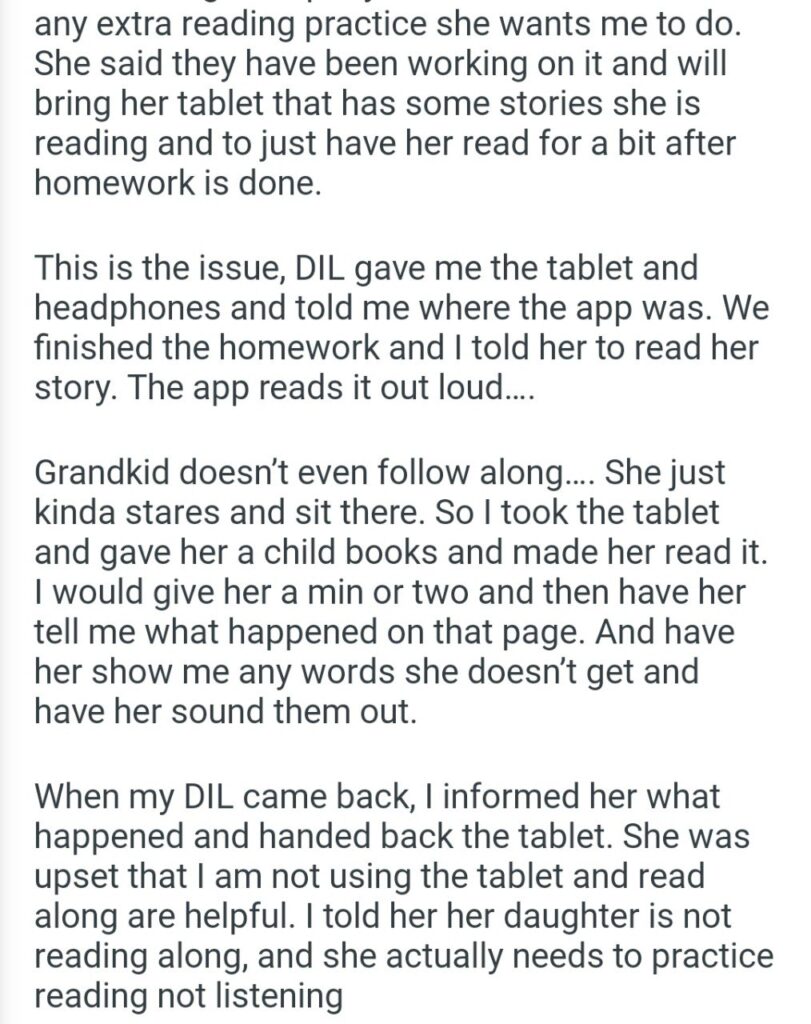
Let’s be real for a second. Listening to a story is great for imagination, but it is not reading. If you are trying to build muscle, you don’t watch someone else lift weights. The OP watched her granddaughter sit there, staring blankly while the iPad narrated the story. She wasn’t following along; she was zoning out. So, the OP did what any responsible adult would do: she took the tablet away.
She replaced the screen with a physical book and went old school. She made the child read out loud, sound out the difficult words, and summarize the page to ensure comprehension. Was the child happy about it? Probably not. Learning to do something you struggle with is frustrating. But it is also the only way to actually learn.
When the DIL came back and found out the tablet had been vetoed, she wasn’t grateful for the free tutoring. She was upset. She insisted that “read-alongs are helpful” and accused the OP of questioning her parenting. The OP stood her ground, pointing out that the child needs to practice reading, not listening.
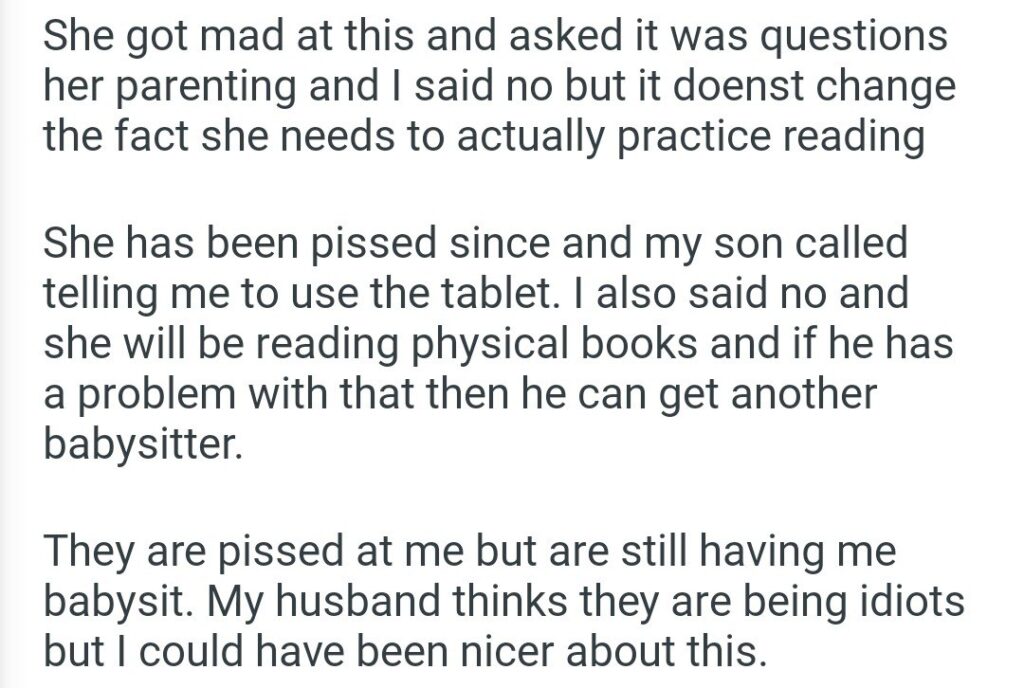
The drama escalated when the OP’s son called to demand she use the tablet. The OP, fully embracing her “I’m doing you a favor” energy, gave them an ultimatum: she will use physical books, and if they have a problem with that, they can find another babysitter.
It is honestly baffling that the parents are angry. Their child is ostensibly a grade level behind, unable to read basic vocabulary, and they are fighting for her right to stare at a screen that does the work for her. The OP notes that despite their anger, they are still dropping the kid off for babysitting. Why? Because deep down they probably know she is right—or they just really like the free childcare.
So, is the OP the a-hole? Absolutely not. She is the only one in the room who seems to prioritize the child’s literacy over the path of least resistance. Audiobooks are fantastic, but they don’t teach you how to decode phonics. This grandma deserves a gold star and a very quiet evening with a book of her own.
What would you do if you realized a child in your care was falling behind and the parents refused to address it? Would you follow orders, or would you force the physical books like this grandma? Let us know in the comments if you think the iPad ban was justified!