We need to have a very serious conversation about the difference between grieving and just being a terrible person. Grief is messy and complicated, and we all handle it differently. But there is a line where “processing trauma” stops and “weaponizing tragedy to terrorize your family” begins. One teenager on Reddit has apparently been sprinting past that line for years, and her dad is cheering her on from the sidelines with a pocket full of excuses.
Our story comes from an 18-year-old girl living in a blended family nightmare. She lives with her brother, her mom, her stepdad, and his 18-year-old daughter. The stepsister has a tragic backstory: her mother passed away during childbirth. That is undeniably awful, and growing up without a mother figure is a deep wound. However, the narrator points out that around age 16, the stepsister started using this tragedy not just as a source of sadness, but as a universal hall pass for bad behavior.
It started with “small” things, if you can call them that. When they were 14, the stepsister lost a game of Uno. Instead of flipping the table like a normal sore loser, she completely trashed the narrator’s room. We are talking posters ripped down and bed sheets ruined. And what was the consequence? Her dad gave the victim ten dollars—ten dollars!—and told her not to take it to heart because the vandal was “upset from not having a mother figure.”
I am sorry, but what? Does losing a Draw 4 card trigger a specific type of maternal grief I am unaware of? That is not how that works. But the enabling didn’t stop there. It escalated to actual property damage. When the narrator’s brother got his first car, the stepsister demanded he be her personal chauffeur. When he said no, she scratched up the paint and ruined it.
The excuse from the parents? “She’s just not in the right mindset because she misses her mom.” Let’s be real for a second. She didn’t key the car because she was sad. She keyed the car because she was told “no” and she has never faced a consequence in her life. This isn’t grief. It is entitlement wrapped in a tragedy.
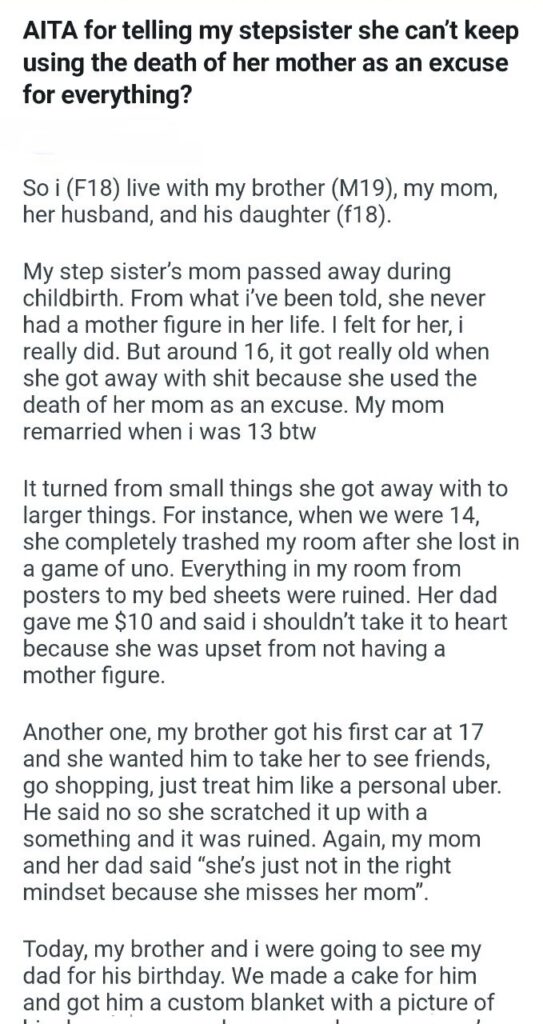

The situation finally exploded on the narrator’s father’s birthday. She and her brother had prepared a thoughtful gift: a custom blanket with a picture of his recently deceased dog and a homemade cake. As they were leaving, the stepsister threw a fit because she wasn’t allowed to go see her friends due to the pandemic rules at the time.
When the narrator returned downstairs to leave, she found a scene from a horror movie. The custom blanket had bleach poured on it. The cake was smashed with a ketchup bottle. This wasn’t an accident. This was a calculated, malicious attack designed to hurt people.
When confronted, the stepsister turned on the waterworks. She started “fake crying” and claimed it hurts seeing them visit their dad when she can’t visit her mom. It is a manipulative masterstroke. She tried to equate visiting a living parent for a birthday with the metaphysical inability to visit a deceased parent, all to justify destroying a memorial gift for a dead dog.
While the mom finally seemed to wake up and get upset, the stepdad swept in with the same tired line. He told them it “wasn’t a big deal” and that they could just “get a new one.” He actually told them to “cut her some slack” because she misses her mom.
Our hero finally snapped. She told her stepsister that she cannot keep using her mother’s death as an excuse for everything. She called her out for being a “b**ch” and refused to let it slide. Now the dad wants an apology because the narrator will “never understand the pain of losing a parent.”
So, is she the ahole? Absolutely not. N-T-A. The stepdad is failing his daughter by turning her into a monster who thinks her trauma gives her the right to abuse others. You don’t cure grief by enabling vandalism. The stepsister needs therapy, not another free pass to destroy her family’s property.
NTA but your step sister is a manipulative brat. She has seen what her trauma of loosing her mom gets her and her dad is a chump for feeding into it. I don’t usually condone getting down to others level of petty, but she would find things of hers destroyed or torn up everytime she acted out and destroyed something of mine. She is to old to be acting like this and soon enough her dad will find out when she takes out her anger on him and his stuff. Get a lock for your door and don’t leave anything you cherish out where she can get her bratty hands on. Her dad needs to wake up and stop making excuses for her crap