There are a few hard and fast rules for giving a wedding speech. Keep it short, don’t get too drunk beforehand, and for the love of all that is holy, do not make it about yourself. One maid of honor on Reddit seems to have skipped that last, crucial memo, and in doing so, turned a heartfelt speech into a masterclass in how to make a bride uncomfortable on her own wedding day.
Let’s set the scene. Our narrator, a 27-year-old woman, has been best friends with the groom, Christian, since they were freshmen in high school. Theirs is a long, storied friendship, complete with one little wrinkle: for three years in high school, Christian had a massive, unrequited crush on her. But he got over it, they stayed friends, and their bond even grew stronger. A classic tale.
Fast forward to the present. Christian has met the love of his life, Victoria, and they are getting married. The narrator and Victoria have a decent relationship, and everyone is on the same page about Christian’s old, long-dead feelings. The wedding is beautiful, everyone is happy, and it’s a perfect celebration of love.
Then, it was time for the speeches. The narrator, as one of the groom’s oldest and closest friends, got up to say a few words. And it started off beautifully. She talked about how they first met, their shared history, and what a wonderful person Christian is. The crowd was touched. The bride and groom were beaming. It was everything a wedding speech should be.
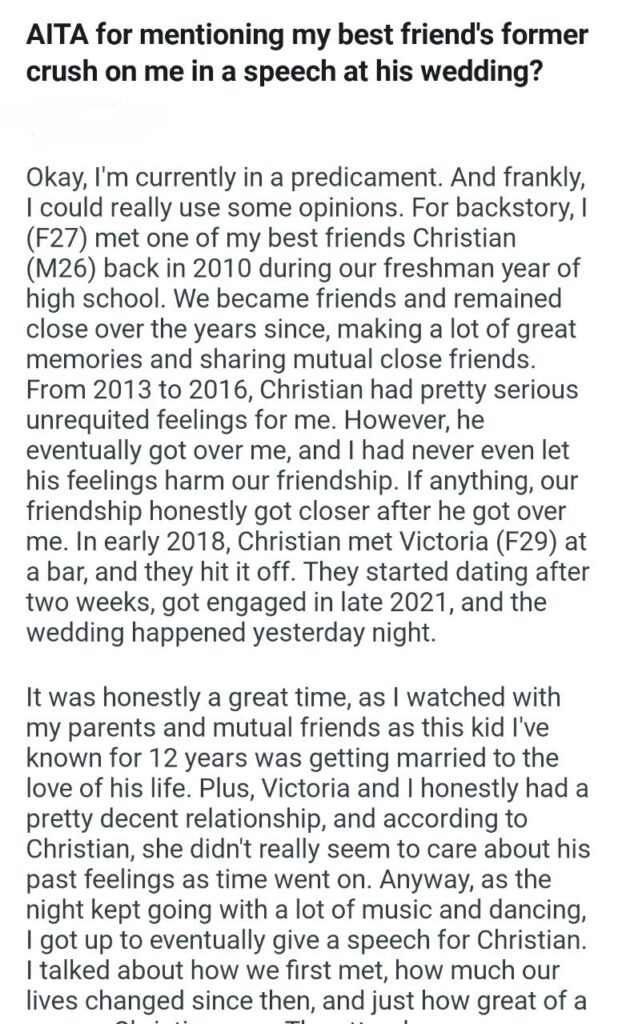
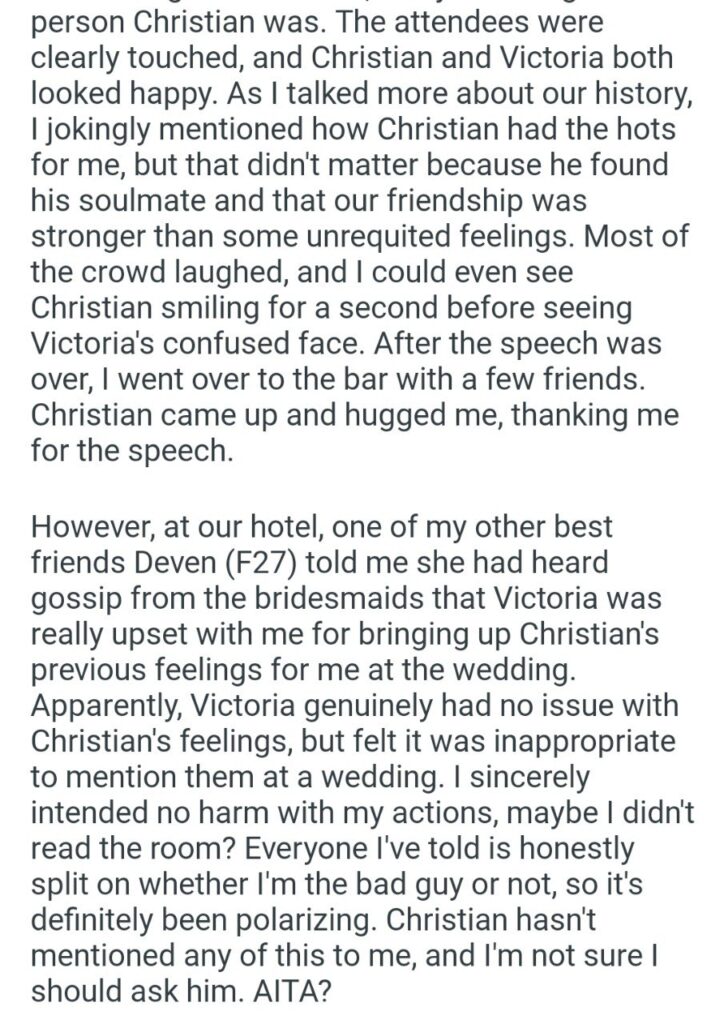
And then, just as she was about to stick the landing, she decided to take a bizarre and unnecessary detour. As she was reminiscing about their history, she thought it would be a great idea to jokingly mention that Christian used to have “the hots for me.” She quickly followed it up by saying it didn’t matter because he found his soulmate, but the damage was already done.
In that moment, the speech stopped being about Christian and Victoria’s love story and became, for a brief, cringeworthy second, about her. It was a verbal record scratch. She centered herself in their narrative, reminding everyone, including the bride, that before this great love story, there was his great unrequited love story for her.
The crowd gave a little laugh. She even saw Christian smile for a second, before his eyes darted to his new wife’s face, which had morphed from happy to confused. The bride was, understandably, not in on the joke. The speech ended, and the narrator went on with her night, blissfully unaware of the social grenade she had just detonated.
Later that night, the truth came out via the bridesmaid gossip grapevine, the most reliable news source at any wedding. Victoria was, in fact, really upset. It wasn’t that she was insecure about the old crush. She was upset because bringing it up during a wedding speech was profoundly tacky and inappropriate. And she is one hundred percent right.
A wedding speech is a tribute to the couple’s journey together. It is not an open mic night to air out the groom’s romantic history, no matter how innocent or one-sided it was. It puts the bride in an incredibly awkward position. How is she supposed to react? She has to sit there and smile while one of her husband’s friends makes a joke about how he used to want her instead.
So, is the narrator the ahole? Yes. A well-intentioned ahole, perhaps, but an ahole nonetheless. Her intentions were harmless, but the impact was what mattered. She failed to read the room, the country, and the continent. The fact that Christian hugged her afterward doesn’t mean it was okay; it means he’s a good guy who was trying to avoid drama on his wedding night.
This wasn’t a joke for the happy couple. It was a joke for her and her mutual friends, at the bride’s expense. She may not have meant any harm, but she owes Victoria a sincere and heartfelt apology for her massive lapse in judgment.