The transition from “friend” to “person I want to date” is a treacherous road, but the journey back to “just friends” after a rejection is even rockier. We have all seen it happen. One person catches feelings, shoots their shot, and gets shot down. Ideally, things go back to normal after a brief period of awkwardness. But sometimes, the dynamic shifts so drastically that it makes you wonder if the friendship was ever genuine in the first place, or if it was just a transaction waiting to be completed.
A twenty-one-year-old college student on Reddit is currently in the middle of this exact dilemma. He has been friends with a girl named Annie for three years. They are part of the same crew, they hang out every Saturday night, and they have established a routine. For years, the OP (Original Poster) has walked Annie back to her dorm after their hangouts before heading back to his own place. It was a nice, safe, gentlemanly thing to do.
But the status quo changed when the OP decided to ask Annie out. She didn’t feel the same way and told him she wanted to remain friends. The OP says it didn’t bother him “too much,” but his actions suggest otherwise. He decided he wanted to cut back on the friendship a bit. While they remained amicable in the group setting, the late-night walks came to an abrupt halt. He stopped engaging in the protective ritual they had maintained for years.
For the first couple of weeks, Annie walked herself home without incident. But recently, the situation got complicated. Annie was drunk, it was midnight, and she was scared to walk alone. She asked the OP if he could walk her back, reverting to their old safety system.
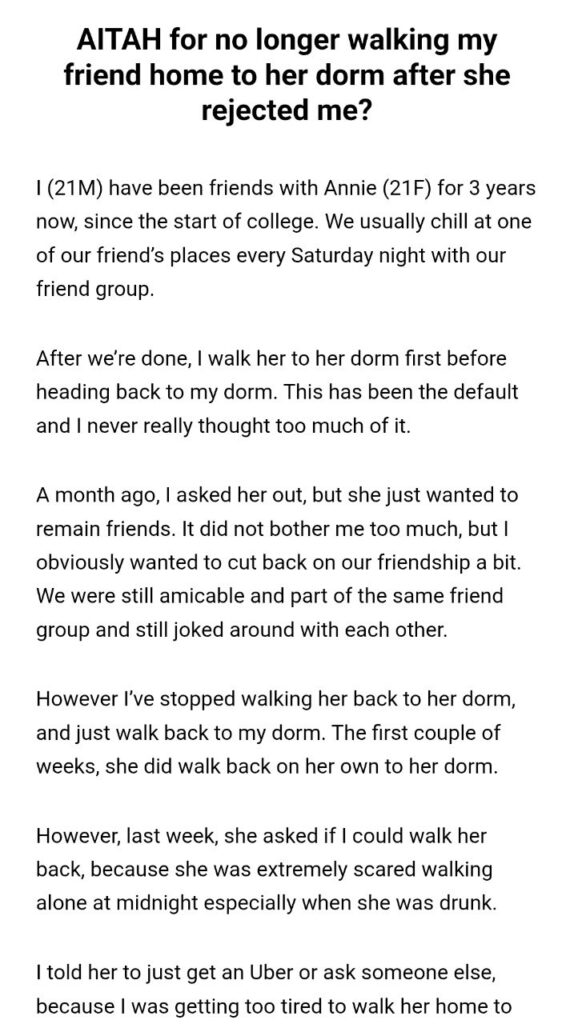
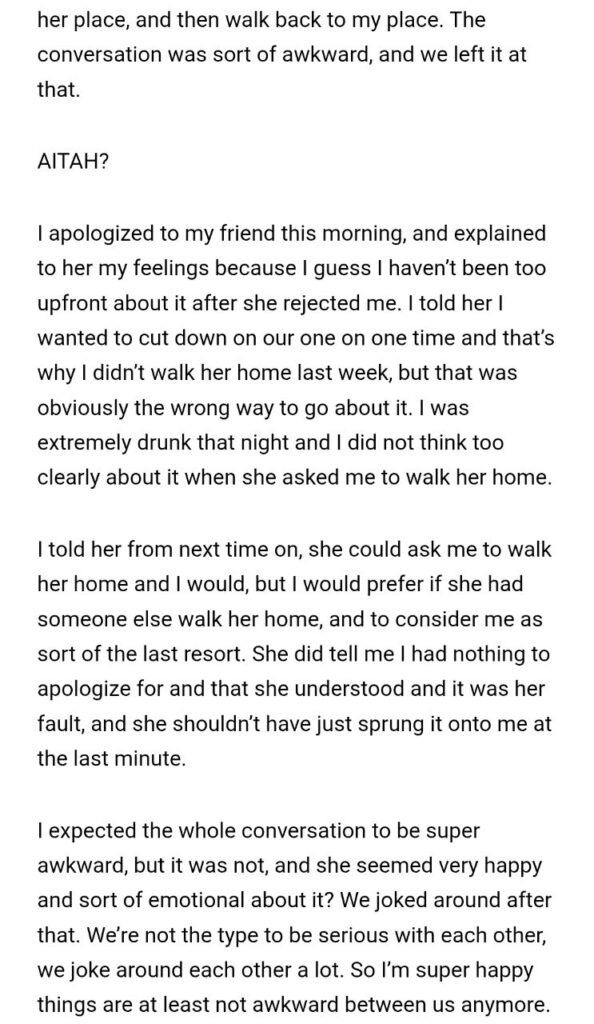
The OP’s response was ice cold. He told her to just get an Uber or ask someone else because he was “getting too tired” to walk her home and then walk back to his place. Basically, he told her that her safety was no longer his problem now that romance was off the table. The conversation ended awkwardly, leaving Annie to fend for herself and the OP asking the internet if he is the jerk.
This story has split the internet right down the middle because it touches on the sensitive concept of “boyfriend privileges.” On one side, you have the argument that walking someone home, especially if it adds extra travel time to your night, is a significant effort. The OP viewed this as an act of courtship, or at least a level of intimacy he no longer wanted to provide. He is trying to distance himself to get over his crush, and acting like her bodyguard might make that harder.
On the other hand, this screams “Nice Guy” syndrome. It suggests that his kindness and concern for her safety were conditional. As long as there was a chance for romance, he was happy to ensure she got home safe. The moment that possibility vanished, her safety became an inconvenience. It makes the last three years of friendship look purely transactional, as if he was putting kindness coins into a machine hoping a relationship would fall out.
There is also the safety aspect to consider. We are talking about a drunk young woman walking alone on a college campus at midnight. Regardless of relationship status, most friends would want to make sure their friends don’t get assaulted or hurt. Telling her to “figure it out” or call an Uber feels less like setting a boundary and more like punishment for rejecting him.
If he was truly just tired, that is one thing. But the timing suggests this is about proving a point. He wants her to feel the loss of his “services” now that he isn’t getting what he wanted. It is a harsh reality check for Annie, who probably thought her friend cared about her well-being regardless of whether or not they were dating.
The OP has every right to protect his heart and draw boundaries. He doesn’t owe her a walk home every single Saturday for the rest of their lives. However, abandoning a drunk friend who explicitly says she is scared is a pretty low move. It sends a loud and clear message: “I only care if you’re safe if there’s a chance I can be your boyfriend.”
So, is the OP the ahole? It is a complex one. He is technically within his rights to stop doing favors, but morally, he left a friend in a vulnerable spot. It proves that while they might still be in the same friend group, the actual friendship might be dead in the water.
What would you do if a friend stopped walking you home after you rejected them? Is he setting healthy boundaries, or is he being a bitter jerk? Let us know in the comments if you think he owed her that walk!