Inheritance drama is a tale as old as time. Usually, families are fighting over money, a vacation home, or grandma’s vintage jewelry. But sometimes, the items in question are worthless to the bank and priceless to the heart. When a parent dies, you expect to deal with grief, but you don’t necessarily expect to deal with a moral dilemma involving a lighter and a stack of teenage journals. One man on Reddit decided to handle his complicated feelings about his late mother by burning the only things she left him, effectively robbing his siblings of their mother’s history in the process.
The OP (Original Poster) had a childhood that sounds like the backstory of a villain in a superhero movie. His mother had an affair, left his dad, and started a shiny new life with a new partner. While the OP stayed behind to care for his brokenhearted father in poverty, his mother was off playing “happy family” with her new kids. It is the classic “do-over” family dynamic that leaves the first batch of kids feeling like discarded drafts.
For years, the OP watched from the sidelines as his half-siblings got the attentive mother he never had. She was too busy raising them to return his calls. Eventually, as she got older, she tried to reconnect, but the OP wasn’t interested. It is hard to blame him; you can’t just clock out of parenting for a decade and then clock back in when it’s convenient. When she passed away, she left him her diaries from her teenage years and letters she had written, hoping that reading them would help him understand her. It was a peace offering from the grave.
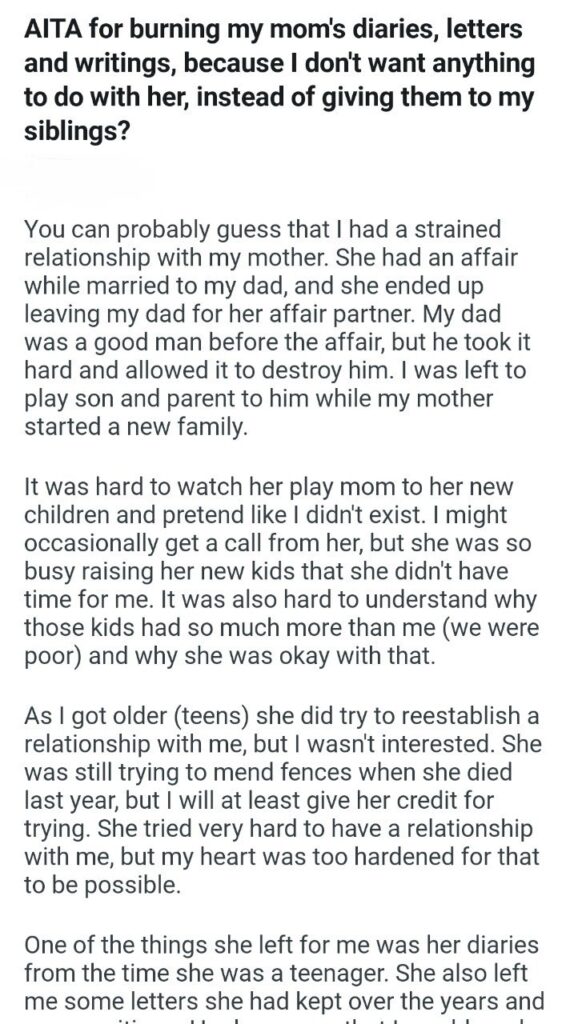
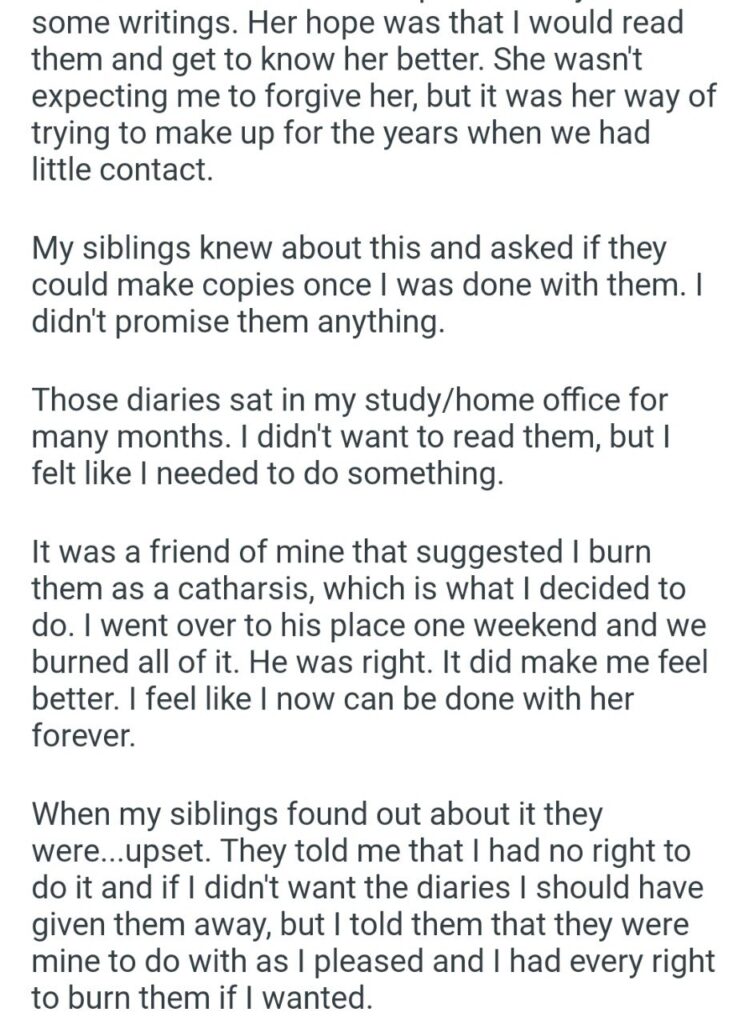
Here is where it gets messy. The OP’s half-siblings—the ones who actually had a relationship with her—knew about the diaries. They asked if they could make copies once the OP was done with them. The OP didn’t promise anything, but he didn’t say no, either. He just let the journals sit in his office for months, radiating bad vibes. He didn’t want to read them. He didn’t want to know her. He just wanted to be free of the resentment.
A friend suggested a ritual burning. It sounds like something out of a bad breakup movie, but for the OP, it clicked. He took the diaries—the only record of his mother’s inner thoughts and youth—over to his friend’s house and torched them. He watched the pages turn to ash and felt a wave of relief. He felt like he was finally done with her.
But while he was having his cathartic moment, he seemingly forgot that he wasn’t the only person on earth who lost a mother. When his siblings found out, they were understandably crushed. They didn’t have the same traumatic relationship with her; to them, she was just Mom. They wanted to read those pages to feel close to her, and the OP destroyed that chance forever.
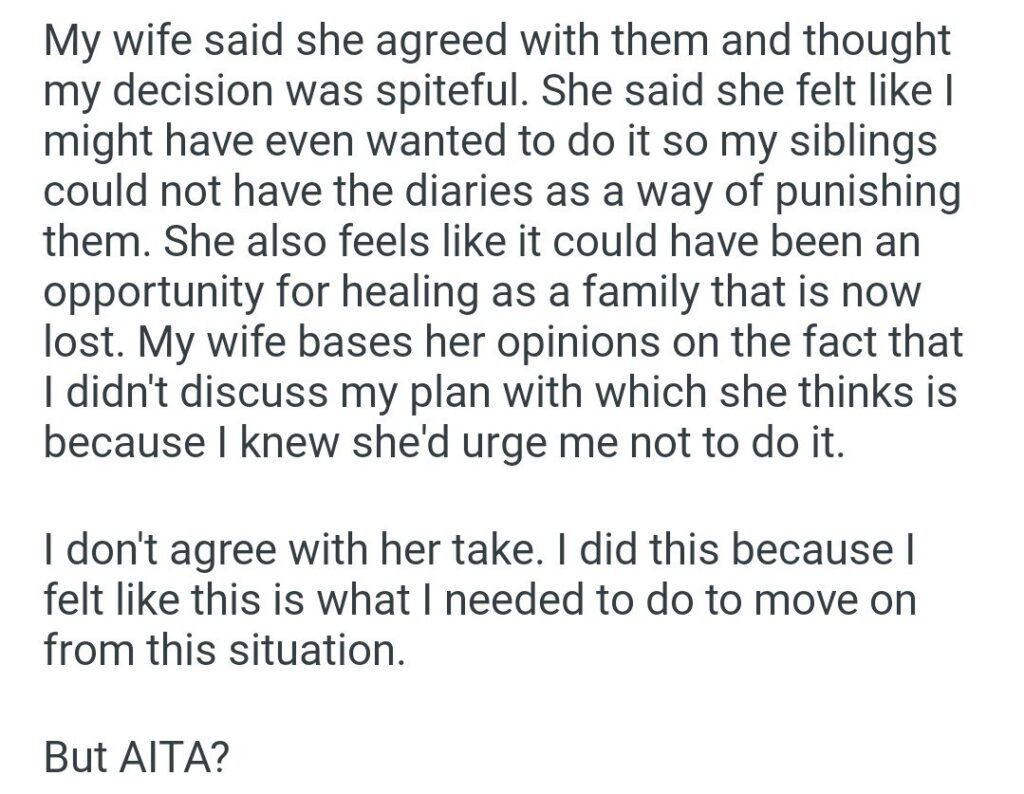
The OP’s wife hit the nail on the head when she called the decision spiteful. She pointed out that he likely did it not just for closure, but to punish his siblings. By burning the diaries, he ensured that the “new family” couldn’t have them either. It feels like a final “screw you” to the kids who got the love he was denied. He destroyed what he hated, but he also destroyed what they loved.
The OP claims he did it to move on, but his wife noted that he didn’t discuss his plan with her because he knew she would stop him. That is the tell-tale sign of a guilty conscience. If you have to hide your “healing journey” from your spouse because you know it is objectively cruel, maybe it isn’t healing; maybe it is just revenge.
So, is the OP the ahole? It is complicated, but yeah, kind of. He had every right to refuse to read them. He had every right to throw them in a box and never look at them again. But to actively destroy them when he knew his siblings desperately wanted them feels less like closure and more like scorching the earth. He let his pain make the final decision, and while he might feel better, he just passed that pain onto his siblings.
What would you do if you inherited something you hated but your siblings loved? Would you hand it over, or would you light the match like this guy? Let us know in the comments if you think this was valid closure or just plain mean!